Is your building compliant?
Radio coverage inside a building is a life safety issue in Miami, not a convenience.
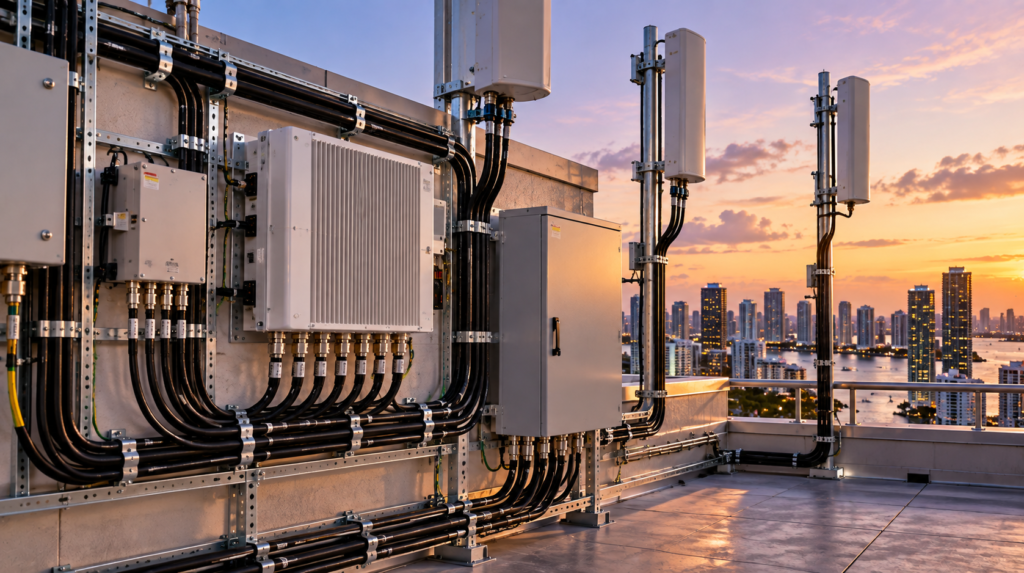
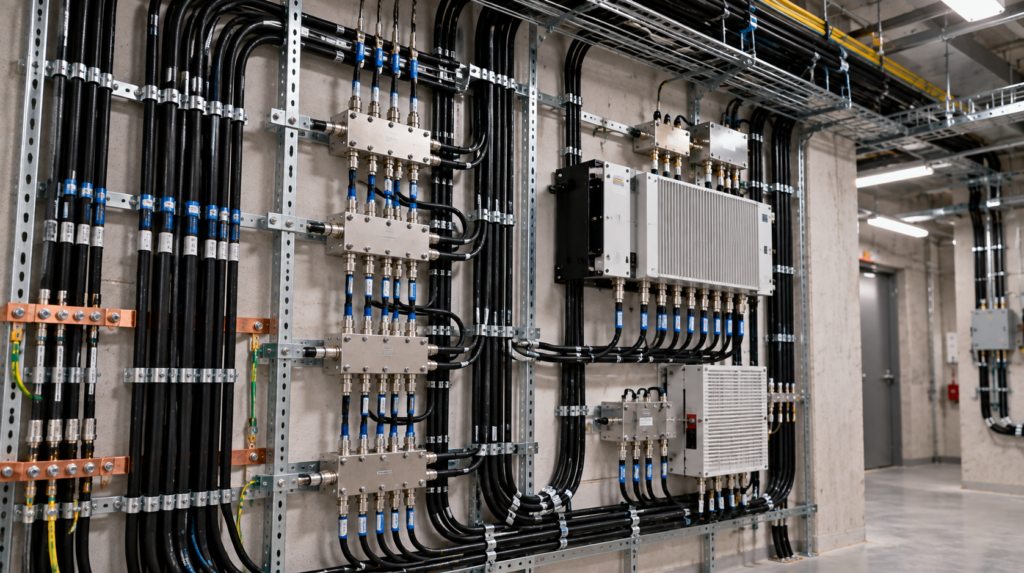
Firefighters, paramedics, and police officers depend on portable radios that frequently fail to penetrate reinforced concrete, impact glass, elevator shafts, and below-grade parking decks. A public safety BDA and DAS system corrects that by capturing outdoor radio signals, amplifying them, and redistributing them evenly through the property so first responders can communicate with each other and with dispatch from anywhere inside.
Secured Technologies, Inc. designs, installs, and maintains BDA and DAS systems for condominiums, commercial buildings, and multi-unit properties across Miami and South Florida. The company is a licensed and insured low-voltage integrator with more than 20 years in the field, and it works brand-agnostic, which means equipment selection follows the engineering requirements of the building rather than a manufacturer relationship.
What a BDA and a DAS Actually Do?
The two acronyms describe two halves of the same solution. A BDA, or bi-directional amplifier, is the engine. It takes weak radio frequency signals arriving from outside, boosts them, and simultaneously amplifies the signals transmitted from inside the building back out to the radio system. Both directions matter. A system that only amplifies inbound traffic lets responders hear dispatch but prevents dispatch from hearing them.
A DAS, or distributed antenna system, is the delivery network. It consists of antennas placed throughout the structure and the cabling that connects them to the amplifier. Without a properly designed antenna network, a single amplifier can only serve a limited area, and signal strength will vary wildly from floor to floor.
System components
-
1
Donor antenna
Mounted outdoors to capture signals from the surrounding radio network
-
2
Bi-directional amplifier
Amplifies signal in both directions and manages gain to prevent interference
-
3
Distributed antenna network
Spreads the amplified signal evenly across floors, corridors, and enclosed spaces
-
4
Cabling and passive components
Carries and splits the signal from the headend to each antenna location
Why Miami Buildings Lose Radio Coverage
South Florida construction is unusually hard on radio signals. Several factors combine in the same building:
Reinforced concrete floors and columns, metal stud framing, and metal roof decks that reflect and absorb radio energy
Impact-rated and low-emissivity glass that blocks a significant portion of outdoor signal
Elevator shafts, stairwells, and mechanical rooms that are heavily fire-rated and densely built
Below-grade parking garages, loading docks, and storage levels with no line of sight to the outside
Large floor plates and long, winding corridors that put distance between a responder and any outdoor signal source
The result is predictable. Crews enter the lobby with clear audio, step into the stairwell or the garage, and lose contact. That is precisely the moment when reliable communication matters most.
The Coverage Requirements That Drive the Design
Public safety in-building coverage is governed by code, and the thresholds are strict. Code calls for 99 percent coverage in critical areas such as the fire command room, fire pump room, stairwells, and elevators. For all other occupied spaces, the requirement is 95 percent coverage. Those numbers are not aspirational targets. They define where antennas must go, how much amplification the system needs, and what the acceptance test has to demonstrate.
The specific edition and language of the code in force, along with the required documentation and testing methodology, are determined by the authority having jurisdiction for the property. Property managers, developers, and condo boards should confirm the applicable requirements with the local fire marshal or building department before finalizing a design. A qualified integrator will typically handle that coordination as part of the project, but the requirement itself originates with the jurisdiction, not the contractor.
BDA and DAS: How the Two Terms Fit Together
People use the two terms interchangeably, and in a public safety context that is usually fine, because the systems are deployed as a pair. The distinction becomes useful when a building is evaluating multiple types of in-building coverage. Distributed antenna systems are also used to improve commercial cellular connectivity for tenants and guests, while a BDA in the public safety sense prioritizes emergency communication for first responders.
The industry also uses the term ERRCS, short for Emergency Responder Radio Communication System, to describe the complete code-compliant assembly of amplification, distribution, monitoring, and documentation. If a bid or a fire marshal notice references ERRCS, it is describing the same category of work as a public safety BDA and DAS installation.
Who Typically Needs a Public Safety BDA or DAS in Miami
Requirements are triggered in several common situations. A building does not need to be brand new to fall under them.
New commercial construction, including office towers, hotels, retail centers, and industrial facilities
Condo high-rises and multi-unit residential buildings, particularly those with below-grade parking
Existing buildings undergoing major renovation or a change of occupancy
Properties that have failed a radio coverage test or received a notice from the fire marshal
Buildings with an older system that no longer meets current coverage thresholds or documentation standards
Because the trigger is local code enforcement, the fastest way to know where a specific property stands is to ask the authority having jurisdiction and, if a system already exists, to commission a fresh coverage test.
What a BDA and DAS Project Looks Like From Start to Finish
A well-run project follows a defined sequence. Skipping or compressing any step tends to show up later as a failed inspection or a system that works on paper but not in the stairwell.
RF site survey. Technicians walk the building with test equipment to measure existing signal levels, map dead spots, and identify the construction features causing the loss.
System design. The survey results determine amplifier sizing, antenna placement, cabling routes, and the headend location, with the goal of meeting the code coverage thresholds.
Installation. Crews mount the donor antenna, pull coaxial or fiber cable, install the distributed antennas, and coordinate with other trades so the work does not conflict with electrical, fire alarm, or structural schedules.
Commissioning. The amplifier gain is tuned and the system is balanced so the indoor signal is strong enough to use without creating interference for the surrounding radio network.
Acceptance testing. Coverage is measured and documented against the required percentages, producing the test records the jurisdiction expects to see.
Ongoing testing and maintenance. Once accepted, the system needs periodic verification because the RF environment and the building itself keep changing.
Testing and Maintenance: The Part Most Buildings Underestimate
A public safety BDA and DAS system is life safety equipment, and it should be treated like the fire alarm panel rather than like a Wi-Fi access point. Coverage that passed at commissioning can degrade over time. New construction nearby can change the outdoor signal environment. Tenant build-outs, added walls, and reconfigured mechanical spaces can alter how signal moves through a floor.
Regular testing, plus a written maintenance program, keeps a system inspection-ready and gives property management documentation to show the jurisdiction. Buildings that skip maintenance often discover a problem only after a failed re-inspection or, worse, after an incident.
Modernizing an Existing BDA System
Plenty of South Florida properties already have a system installed, sometimes by a company that is no longer responsive. Older installations can fall short in several ways: coverage that no longer meets current thresholds, amplifiers that do not support the frequency bands in use, undocumented design changes made during renovations, or documentation that was never complete in the first place.
The practical approach is to benchmark the existing system with a coverage test before deciding anything. That data shows whether the system needs tuning, partial replacement, or a full redesign. Because Secured Technologies works brand-agnostic, the recommendation is based on the test results, and the company can service and upgrade systems it did not originally install.
Choosing a BDA and DAS Integrator in South Florida
For property managers and condo boards, the selection criteria are straightforward. Confirm the integrator is licensed and insured, ask how long they have been working in the region, and ask directly whether they are tied to a single manufacturer. A brand-agnostic integrator can match equipment to the building instead of matching the building to whatever is in stock.
Also ask who performs the testing and who produces the documentation. Coverage test records are part of the deliverable, not an afterthought, and the same firm that designs the system should be able to stand behind the numbers at inspection. With more than 20 years serving Miami, Fort Lauderdale, and the surrounding region, Secured Technologies handles BDA and DAS work alongside access control, video surveillance, intercoms, and the structured cabling that often supports these systems.
Frequently Asked Questions
What is the difference between a BDA and a DAS?
A BDA is the bi-directional amplifier that boosts radio signals in both directions, inbound and outbound. A DAS is the distributed antenna network that carries the amplified signal to antennas placed throughout the building. In public safety work the two are installed together, which is why the phrase BDA and DAS is used as a single term for the full system.
Is a public safety BDA or DAS required in Miami?
Public safety in-building radio coverage is required by code in many circumstances, and enforcement is handled by the local authority having jurisdiction. Requirements can apply to new construction, major renovations, and certain existing buildings. Because the trigger depends on the specific property and the code edition in force, confirm the requirement with the local fire marshal or building department.
What coverage percentages must the system achieve?
Code calls for 99 percent coverage in critical areas such as the fire command room, fire pump room, stairwells, and elevators. For all other occupied spaces, the requirement is 95 percent coverage. Those percentages drive the design and are verified through acceptance testing, with documentation submitted for the jurisdiction's review.
How often should a BDA and DAS system be tested?
These are life safety systems, so periodic testing is expected rather than optional. Coverage should be verified on a regular schedule and after significant building changes such as tenant build-outs, added walls, or mechanical reconfigurations. Ask the authority having jurisdiction for the testing intervals that apply and keep the test records on file with the building's other life safety documentation.
Can you service a BDA system another company installed?
Yes. Secured Technologies works brand-agnostic and regularly tests, repairs, and modernizes existing BDA and DAS systems regardless of who installed them. The process starts with a coverage test to establish the current baseline, and the results determine whether the system needs tuning, component replacement, or a full redesign.